

original research
Respirometry in intact kidney slices
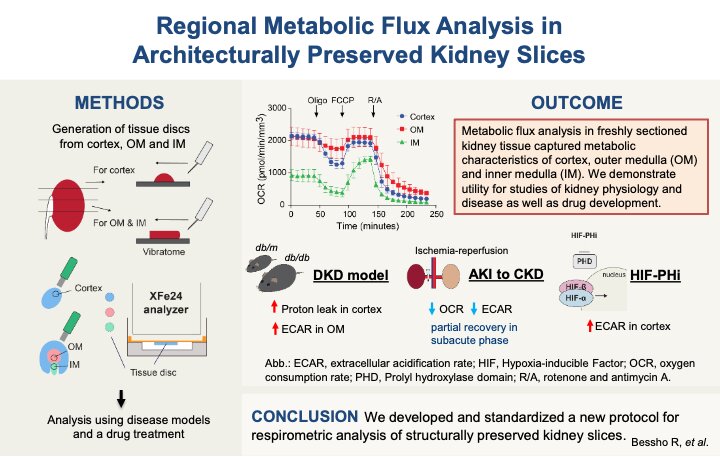
Bessho and colleagues describe a new method for measuring kidney metabolism without taking the tissue apart. In this 2025 American Journal of Physiology-Renal Physiology report, Bessho, Davidoff, Kobayashi, and Haase establish and validate ex vivo respirometry in structurally preserved kidney slices, allowing oxygen consumption and glycolytic flux to be measured simultaneously in the cortex, outer medulla, and inner medulla of the same kidney.
Am J Physiol Renal Physiol. 2025 Dec 1;329(6):716-729. doi: 10.1152/ajprenal.00157.2025. Epub 2025 Oct 10.
Regional metabolic analysis of structurally preserved kidney slices by ex vivo respirometry
Bessho R, Davidoff O, Kobayashi H, Haase VH.
Abstract
A comprehensive spatial analysis of kidney metabolism is essential for advancing knowledge of both normal kidney physiology and pathophysiology. The kidney exhibits marked regional differences in bioenergetic demands and substrate utilization, reflecting the distinct functional profiles of each nephron segment. To complement existing approaches with freshly isolated tubules or primary cell cultures, we established and validated an ex vivo respirometry method using structurally preserved kidney slices on a Seahorse XFe24 platform. This protocol avoids tissue disruption or enzymatic digestion and enables simultaneous, region-specific measurements of metabolic fluxes in the cortex, outer medulla, and inner medulla. It provides an integrated readout of the metabolic properties of the cell types present within each anatomical region. We demonstrate the utility of this approach through proof-of-principle studies that profile region-specific metabolic fluxes under hyperglycemic conditions in a mouse model of obesity and type 2 diabetes, as well as the metabolic alterations that accompany the transition from acute ischemic injury to chronic kidney disease. Furthermore, to highlight its relevance for therapeutic discovery, we applied this method to assess the impact of pharmacological hypoxia-inducible factor activation on regional kidney bioenergetics. In summary, this protocol advances the study of kidney metabolism by providing a robust platform for region-specific analysis of kidney respiration and bioenergetics and holds promise for accelerating the development of novel therapies targeting metabolic pathways in kidney disease.


